The Place-Name Trap: A Name Is a Clue, Not a Full History
A place-name research routine helps you separate a plausible clue from a proven account, using maps, records and careful wording to avoid false certainty.
A place name can suggest a river, a woodland, a person or an old boundary, but its familiar meaning does not prove how the name began. A place-name research routine helps you treat each interpretation as a clue to check, rather than a complete local history in miniature.
Give yourself a week to investigate one name. Keep the question narrow: what explanations are plausible, what evidence supports each one, and what remains unknown? A notebook, a current Ordnance Survey map, access to an old-map collection and a visit to a local library or archive are enough to begin. You are not trying to force a neat origin story; you are learning where the evidence stops.
What should you record before searching?
Start by writing down the name exactly as it appears on a sign or current map, including any hyphen, apostrophe or distinctive spelling. Note which place you mean: several settlements, farms or features can share a name, and a nearby name may have a separate history. Add the county and the relevant parish or civil parish if known.
Then record your first interpretation, but mark it clearly as a guess. If a name sounds as if it contains “ford”, “ham” or “ley”, write down what those elements bring to mind without treating that resemblance as a result. Modern spelling can hide older forms, and similar-sounding words do not necessarily share an origin.
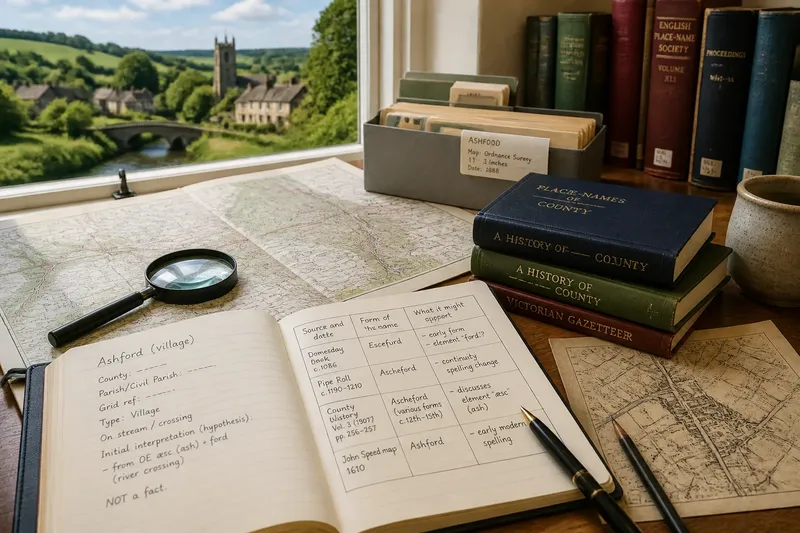
Make a simple evidence table with three columns: “source and date”, “form of the name”, and “what it might support”. Leave space for uncertainty. This prevents an attractive explanation from blending in your memory with something you actually read in a record.
- Write down the place’s precise location and type.
- Copy the current spelling without silently correcting it.
- Note an initial interpretation as a hypothesis, not a fact.
- Record where each later spelling came from.
- Keep alternative explanations visible until the evidence distinguishes them.
Which name forms deserve attention?
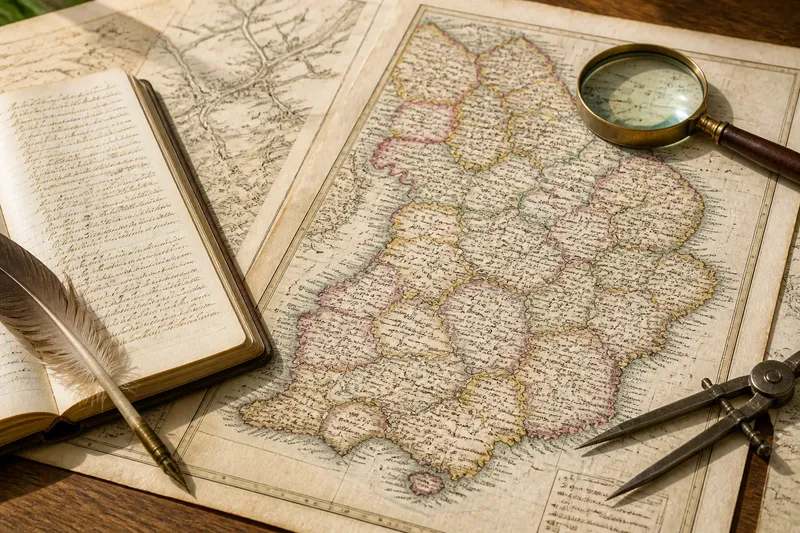
During the first part of your week, look for recorded forms that predate the spelling now in use. Consult a county history or place-name dictionary in a reference library, a local archive catalogue, and reputable map collections. Historic maps can show changing spellings and the name’s relationship to nearby features, but they are not automatically the earliest or most authoritative record. Check the map’s date and scale, and note whether it labels a village, a house, a field or a watercourse.
When a source gives a spelling, copy it faithfully and retain the source’s wording about its date. Do not assume that a printed transcription reproduces an original document perfectly; the editor may have expanded abbreviations, normalised letters or made a reading choice. If an archive image is available, compare the transcription with the image, while remembering that handwriting can be difficult to interpret.
Look for repeated forms in independent sources rather than collecting many copies of one claim. A modern website quoting an old county book is not a second witness to that book’s evidence. Follow citations back towards the record, and note when a source offers an interpretation without showing the forms or documents behind it.
Say you are investigating “Ashford” in a county with several places of that name. A current map places one village beside a stream, making a water crossing seem plausible. If older records show different spellings and a reliable account discusses them, that evidence may help assess the idea; the present-day setting alone cannot establish it. Your notes should keep the map observation separate from the historical claim.
How do you test a plausible explanation?
Midweek, compare the recorded forms with the proposed meaning. Ask whether the explanation accounts for the older spellings, not just the sound of the current name. Check whether the suggested element appears in a form that could reasonably have developed into the modern spelling, and whether the interpretation fits the source’s linguistic context.
Place names are often built from elements that have shifted in sound or meaning, and a spelling can be reshaped by later speakers, clerks or mapmakers. A familiar modern word may therefore be a misleading guide. A place-name specialist or an authoritative county reference may clarify a proposed element, but distinguish the source’s explanation from your own inference.
Consider the surrounding geography as supporting context, not a verdict. A name interpreted as referring to a wood might fit a landscape with woodland, but trees could have been cleared or planted after the name arose. A nearby stream may make a water-related reading worth checking, yet proximity does not show that the name describes that stream. Ask whether the feature is securely identified and whether the proposed meaning is supported by name forms as well as landscape.
Keep competing readings in the table. For each one, write what evidence would be expected if it were correct and whether the sources supply it. If a suggestion depends on a single resemblance, label it weak. If a reference work supports an interpretation with a chain of earlier forms, describe it as a supported explanation, not as certainty beyond the evidence.
What can you conclude from the evidence?
Near the end of the week, sort your notes into three categories: directly recorded facts, interpretations supported by a source, and unresolved possibilities. A dated map showing a spelling belongs in the first category. A reference work’s explanation belongs in the second. A guess based on how the name sounds belongs in the third unless stronger evidence emerges.
Use wording that matches each category. “A map labels the settlement…” reports a source. “The county reference interprets the earlier form as…” reports an interpretation. “The name may refer to…” signals a possibility. Avoid writing that a name “means” something unless the evidence and your source justify that level of confidence.
Check the geographical object once more before drafting. A name attached to a parish, a stream and a settlement may have moved between them or been applied to more than one feature. Compare labels across maps and records, and avoid transferring an explanation from a neighbouring place simply because the names look alike.
If sources disagree, state the disagreement and identify what each source relies on. Do not settle it by choosing the more vivid story. A lack of accessible early forms is a real limit: it may leave the origin uncertain even when one explanation sounds especially convincing.
Which questions help keep the account honest?
Does a name’s modern spelling reveal its original meaning?
Not by itself. Spelling can change over time, so earlier recorded forms and a credible linguistic explanation matter more than a present-day resemblance.
Can the landscape prove what a place name means?
Landscape can make an interpretation plausible, but it cannot establish the name’s origin alone. Check whether the proposed meaning also fits the recorded forms and the feature the name originally identified.
What if two sources give different origins?
Compare their evidence, dates and citations rather than treating the disagreement as a vote. If neither explanation can be resolved from the available material, report both with their limits.
When is a place-name origin still unknown?
It is reasonable to say so when the early forms are missing, hard to identify or open to more than one credible reading. An honest uncertainty is more useful than a confident story built on sound alone.
How can you present the result clearly?
On the final day, write a short account in this order: identify the place; give the earliest useful form you located and its source; explain the leading interpretation; then state the evidence that supports it and the main uncertainty. Include a map or record reference where a reader can trace your claim, and distinguish your own observations from a source’s conclusions.
Keep the prose concrete. Instead of saying a village name “tells the story of its origins”, explain that a particular map records a particular spelling, while a named reference interprets that form in a particular way. If you cannot verify an early spelling, say that your search located no reliable early form; do not imply that none exists.
A good place-name research routine does not strip a name of its interest. It shows how a word connects to records, language and landscape without pretending those clues deliver a complete history. The most useful account may end with a precise boundary around what can be said: one interpretation is better supported, another remains possible, and the evidence does not yet settle the rest.
Before sharing your account, reread every sentence that states an origin and ask, “Which source or observation supports this?” If the answer is only that the name sounds right, recast the sentence as a question or leave it out. That small edit keeps a place-name clue in its proper place.